

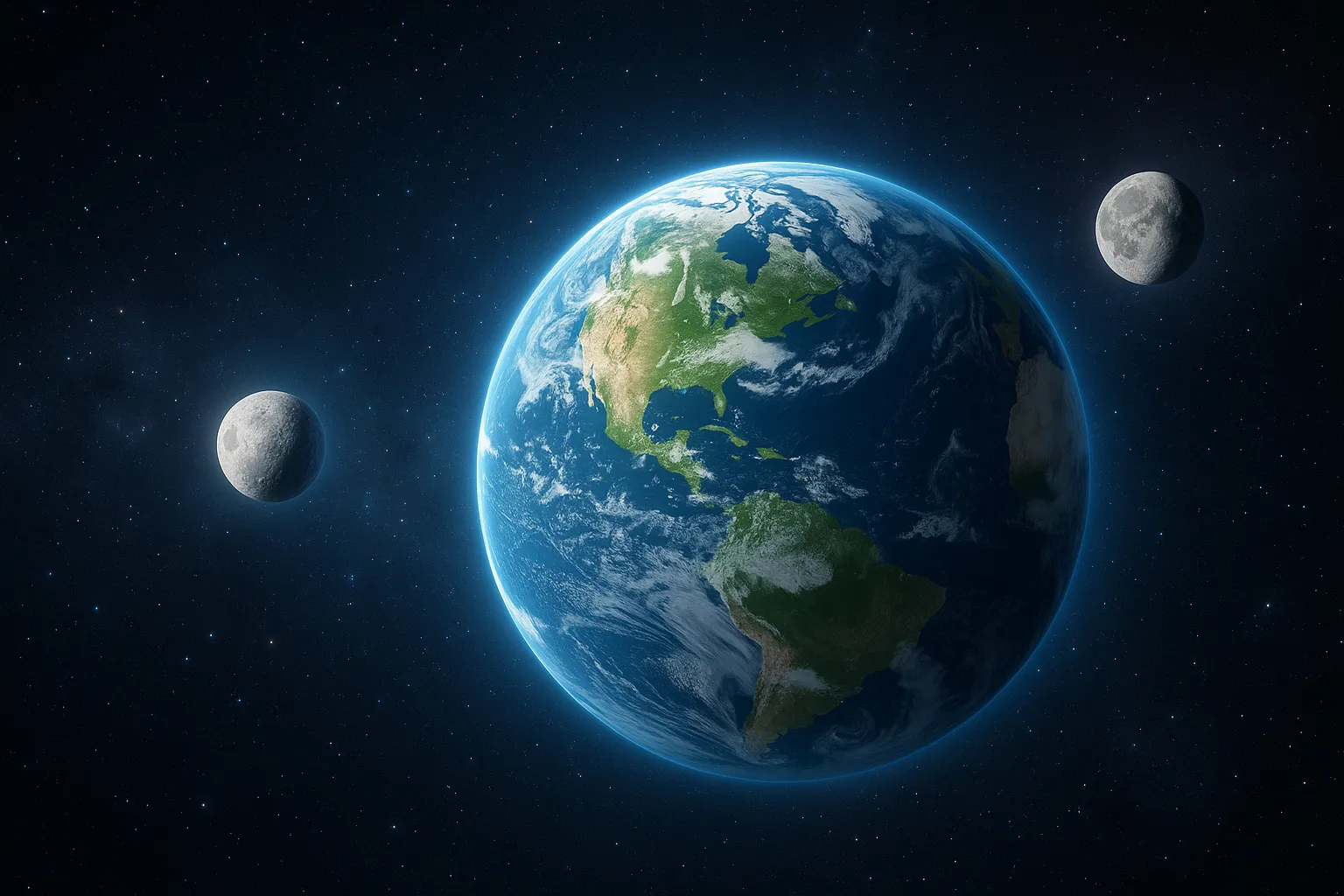
NASA Confirms Earth Has a Second Moon: What You Need to Know About 2025 PN7
In a discovery that feels like it came straight out of science fiction, NASA has confirmed that Earth now has a second moon—at least temporarily. This small celestial companion, officially named 2025 PN7, is classified as a “quasi-moon.” Unlike our familiar Moon, this quasi-moon does not orbit Earth directly but shares a similar orbit around the Sun. Scientists predict that it will remain in Earth’s vicinity until 2083, providing a rare opportunity to study near-Earth objects.
This groundbreaking discovery has sparked curiosity among astronomers, space enthusiasts, and casual observers alike. Let’s dive into what makes this second moon special, how it was discovered, and why it matters for science and space exploration.
What Is a Quasi-Moon?
The term quasi-moon might sound confusing, but it is relatively simple. A quasi-moon is a type of asteroid that shares an orbit with a planet but does not orbit the planet itself. Instead, it moves in a synchronized path around the Sun that keeps it near Earth.
Unlike the Moon, which is gravitationally bound to Earth, a quasi-moon like 2025 PN7 appears to follow our planet but is technically independent. Imagine a cosmic shadow that keeps pace with Earth without being tethered—this is what astronomers mean by a quasi-moon.
This discovery challenges our traditional understanding of moons and highlights the dynamic nature of objects in near-Earth space.

Discovery of 2025 PN7
The asteroid 2025 PN7 was first observed in August 2025 by the University of Hawaii’s Pan-STARRS Observatory, one of the world’s leading tools for detecting near-Earth objects (NEOs). Further analysis confirmed that this asteroid had been traveling near Earth for decades, quietly following its cosmic dance.
NASA scientists calculated that 2025 PN7 will continue its synchronized orbit with Earth until approximately 2083, maintaining distances ranging from 4 million kilometers to 17 million kilometers. Despite its proximity, the asteroid is extremely small and faint, making it invisible to the naked eye and most amateur telescopes.
The discovery underscores the importance of advanced telescopes and observation programs in monitoring near-Earth objects, many of which remain hidden until they are precisely tracked by experts.
Why the Discovery Matters
While the quasi-moon 2025 PN7 poses no threat to Earth, its presence is highly significant for several reasons:
- Scientific Study: Quasi-moons provide a natural laboratory for studying the behavior of near-Earth objects. By observing 2025 PN7, scientists can learn more about asteroid composition, orbital mechanics, and the influence of gravitational forces in the Solar System.
- Planetary Defense: Monitoring quasi-moons helps prepare for potential threats from larger asteroids. Understanding the paths and behavior of these objects improves planetary defense strategies in case of a collision risk.
- Space Exploration Opportunities: A nearby quasi-moon like 2025 PN7 could one day be a target for robotic missions or sample collection. Its predictable orbit makes it an ideal candidate for studying asteroids up close without traveling far into deep space.
- Public Awareness: The idea that Earth has a second moon captures the public’s imagination, encouraging interest in astronomy, space science, and STEM fields.

How Quasi-Moons Differ from Natural Moons
Most people are familiar with the concept of a natural moon, like our familiar lunar companion. Natural moons are gravitationally bound to their planet and orbit it directly. Quasi-moons, however, share a more complex relationship with their host planet:
- Independent Orbit: Unlike the Moon, quasi-moons orbit the Sun, not Earth.
- Temporary Companions: Quasi-moons may stay near Earth for decades or centuries but can eventually drift away due to gravitational influences.
- Smaller Size: Quasi-moons like 2025 PN7 are typically very small, ranging from a few meters to tens of meters in diameter.
Despite these differences, quasi-moons are fascinating because they temporarily become part of Earth’s extended gravitational family, adding an unexpected twist to our understanding of nearby space. NASA Confirms Earth Has a Second Moon.
The Cosmic Journey of 2025 PN7
NASA Confirms Earth Has a Second Moon, NASA and astronomers are closely monitoring the orbital path of 2025 PN7. Its journey around Earth and the Sun is highly predictable, making it an excellent case study for astrophysicists. Scientists predict that 2025 PN7 will remain Earth’s cosmic companion for nearly 60 years, giving researchers ample time to study its characteristics and behavior.
During its journey, 2025 PN7 will maintain a safe distance from Earth, ensuring there is no risk of collision. Its orbital path brings it as close as 4 million kilometers and as far as 17 million kilometers—well beyond the Moon, which orbits approximately 384,400 kilometers away.
What This Discovery Means for the Future
The discovery of 2025 PN7 highlights the dynamic and ever-changing nature of space around Earth. Quasi-moons may not be permanent residents, but they provide invaluable opportunities for scientific research and public engagement.
- Enhanced Space Surveillance: Tracking quasi-moons improves our ability to monitor near-Earth objects that could pose risks in the future.
- Scientific Missions: Future missions could visit quasi-moons to collect samples, providing insights into asteroid composition and the early Solar System.
- Public Curiosity: The idea of a second moon captures the imagination, inspiring future generations to explore space.
By studying these temporary companions, scientists gain new knowledge about the complex dynamics of our Solar System, including how small objects interact with planets over long periods.
Final Thoughts on NASA Confirms Earth Has a Second Moon
While Earth’s familiar Moon continues its steady orbit, the arrival of a second, temporary quasi-moon adds a fascinating chapter to our planet’s story. 2025 PN7 is a cosmic reminder that space is full of surprises, many of which are yet to be discovered.
This quasi-moon won’t be visible without advanced telescopes, but knowing it’s there until 2083 adds a new layer of wonder to our understanding of Earth’s place in the universe. For scientists, it’s an opportunity for research. For the public, it’s a cosmic curiosity that sparks imagination.
Whether you’re an astronomy enthusiast or just love incredible space news, the discovery of Earth’s second moon proves that our planet has more companions than we ever imagined.












Leave a Reply